
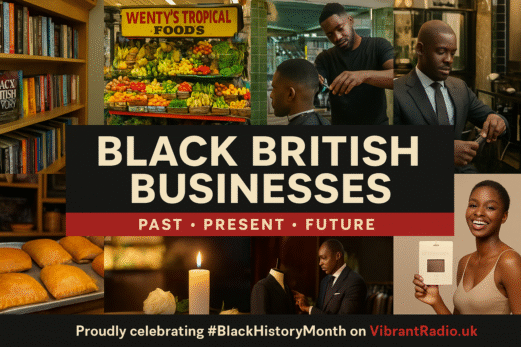
This October, join us as we honour the trailblazers who’ve shaped our communities. From barbershops ✂️ to bookshops 📚, funeral directors ⚱️ to retailers 🛍️, Black-owned businesses are the heartbeat of our heritage.
Tune in to Vibrant Radio UK for special features, stories, and music that celebrate our rich legacy. Let’s uplift and support Black British entrepreneurs together.
Black History Month is more than a time for reflection — it’s an opportunity to celebrate the achievements, endurance, and creativity of Black-owned businesses that have shaped Britain’s cultural and economic landscape.
Across generations, these enterprises have done more than provide goods and services; they have built spaces of belonging, self-expression, and empowerment. From bookshops and bakeries to barbershops and fashion houses, the story of Black British business is a story of community strength.
The Pioneers: Building Foundations (1930s–1970s)
League of Coloured Peoples (1931)
Founded by Jamaican physician Dr Harold Moody, the League fought against racial discrimination and promoted civil rights long before the formal equality legislation of later decades. Its publication The Keys provided a vital platform for early Black British voices.
New Beacon Books (1966)
Britain’s first Black-owned bookshop and publisher, founded by John La Rose and Sarah White, became a cornerstone of the Black Education Movement. It remains active today, promoting Caribbean, African, and Asian literature and nurturing generations of writers and thinkers.
Dyke & Dryden Ltd (1968)
Trailblazers Len Dyke, Dudley Dryden, and Tony Wade revolutionised the Black beauty industry, creating hair and skincare products for the Afro-Caribbean community at a time when few others catered for it. Though the company later changed form, its legacy paved the way for the modern Black beauty sector.
The Mangrove (1968)
Frank Crichlow’s Notting Hill restaurant was more than a place to eat — it was a cultural landmark. The Mangrove became a safe haven for the community, a space for activism, and the heart of the Mangrove Nine civil rights case, which exposed systemic racism in British policing.
Gee’s Barbers (c.1970)
Opened by Clevent “Mr Gee” Artrey in Kensal Rise, Gee’s was one of London’s first Black barbershops. For more than 50 years, it stood as a community meeting place — part salon, part social hub, part institution — embodying the spirit of Caribbean enterprise and connection.
Cultural & Community Anchors (1970s–1990s)
Aquarius Hair Salon (1970s–present)
Founded by Cislin Parry in Finsbury Park, Aquarius remains one of North London’s oldest Black-owned hair salons. Family-run for more than four decades, it has empowered generations of women and continues to adapt, offering modern haircare while keeping its strong community focus.
Sunrise Bakery (1966–present)
A family business based in Birmingham, Sunrise Bakery has supplied Caribbean bread, patties, and buns for nearly six decades. Passed through generations, it remains one of the UK’s longest-running Black-owned food producers, a household name for authentic island flavours.
Wenty’s Tropical Foods (1986–present)
Founded by Wentworth “Wenty” Newland, who arrived from Jamaica in 1967, this Forest Gate grocery began from the back of his car — selling yams, plantains, and sugar cane around East London. Nearly 40 years on, Wenty’s Tropical Foods remains a beloved local fixture run by his daughters, carrying forward both his legacy and his love for community.
Modern Innovators and Trailblazers (2000s–Present)
Ozwald Boateng (est. late 1980s)
One of the first Black tailors to open a boutique on Savile Row, Boateng redefined British menswear with his bold designs and modern vision, influencing fashion globally while championing representation.
Nubian Skin (founded 2014)
Created by Adele Dejak to address the absence of inclusive “nude” tones in fashion, Nubian Skin reshaped the lingerie and hosiery market for women of colour — blending entrepreneurship with empowerment.
The Black Farmer (est. 2000s)
Founded by Wilfred Emmanuel-Jones, this food brand is synonymous with premium British produce and rural inclusivity. Emmanuel-Jones, often called “The Black Farmer,” broke barriers in UK agriculture and became a strong advocate for diversity in business.
Chishuru (founded 2020)
Chef Adejoké Bakare transformed her supper-club pop-ups into a Michelin-starred restaurant celebrating West African fine dining — making history in 2024 as the first Black woman in the UK to receive a Michelin Star.
Barbershops: The Heartbeat of the Community
Across the decades, Black barbershops and salons have served as more than grooming spaces — they are centres of storytelling, solidarity, and cultural continuity.
From 1950s pioneers like Carmen Maingot and Winifred Atwell, who opened some of London’s first Black hair salons, to local institutions inspired by shows like Desmond’s, these spaces have offered belonging, conversation, and connection across generations.
The Ongoing Legacy
Each of these enterprises — from New Beacon Books to Wenty’s, from Gee’s Barbers to The Black Farmer — represents the endurance and innovation of Black British entrepreneurship. Their stories remind us that business success isn’t just measured in profit, but in people, pride, and perseverance.
As we celebrate Black History Month, let us honour these trailblazers and support the new generation following in their footsteps — continuing a proud legacy of creativity, resilience, and community spirit.


Post comments (0)